Welcome to my blog on Quality, elearning, OER, OEP, OEC, and user generated content (UGC)


The posts in my blog will be both in English and Swedish.
Blogposterna kommer att vara både på svenska och engelska.

Wednesday, December 5, 2012

Towards a Nordic Alliance for Open Education


OER on the agenda – globally, in Europe, and in the Nordic countries

Androulla Vassiliou, Commissioner for Education, Culture, Multilingualism and Youth, said: Rethinking education is not just of question of money: whilst it is true that we need to invest more in education and training, it is clear that education systems also need to modernise and be more flexible in how they operate to respond to the real needs of today's society. Europe will only resume sustained growth by producing highly skilled and versatile people who can contribute to innovation and entrepreneurship. Efficient and well-targeted investment is fundamental to this, but we will not achieve our objectives by reducing education budgets.

Open Educational Resources are discussed widely on a global, European and even Nordic level. UNESCO, which has coined the term Open Educational Resources (OER) some 10 years ago, published in June 2012 a global agenda for OER, the Paris Declaration (adopted by OER World Congress). The Declaration shows the importance of Open Educational Resources and gives recommendations to governments and institutions around the globe. The European Union has started a large-scale initiative on “Opening Up Education” and the Cyprus EU Presidency in cooperation with the Norwegian Ministry of Education and Research organises a Ministerial Conference on “Opening up education through technologies” in Oslo in beginning of December. The Ministerial Conference "Opening up education through technologies: Towards a more systemic use for a smart, social and sustainable growth in Europe" to be held in Oslo, Norway on 9-11 December 2012. The conference will constitute a unique opportunity to capture the key issues that matter for a systemic approach to educational innovations which facilitate quality 21st century education for all. Our goal is to dedicate particular attention on how education and training systems can fully reap the benefits of modern technologies so as to create innovative ways of accessing learning content, building creative learning environments and fostering virtual learning communities

Towards a Nordic Alliance for Open Education 

These developments have been the starting point for a Nordic initiative on promoting and utilizing Open Education in the Nordic countries with a focus on creating a strong base for OER and Open Educational Practices (OEP) amongst the Nordic countries and in the Nordic region, also with a global outreach in mind. The Nordic countries have the potential to become a forerunner in OEP and the use of OER activities in Europe. The Nordic OER Alliance is a network of individuals representing stakeholders and institutions supporting uptake, adoption and collaboration around Open Education Resources. The Alliance will have a 3 - 5 year perspective, and is now planning actions to sustain a broad awareness, knowledge building and networking platform. The main objectives of the group are:

  1. To contribute in utilizing OER for educational development in the Nordic countries and to enable and support collaborative actions in these countries
  2. To contribute to global educational development
  3. To support the implementation of the Paris OER Declaration and future EU OER initiatives in the Nordic countries
  4. To analyse opportunities and barriers for a successful implementation of the Paris Declaration as well as current EU strategies in order to provide guidance for policy makers in governments, institutions and organisations
  5. To build and exchange knowledge on OER and OEP in the Nordic Region as a basis for good practices, inspiration for policy building and policy implementation


The Nordic OER Alliance aims at contributing to:
  1. Enabling and supporting collaborative actions
  2. Analysing opportunities and barriers for a successful implementation of the different initiatives such as the UNESCO Paris Declaration in order to be a relevant and strong partner for dialogue and advise for policy makers in governments, institutions and organisations
  3. Creating a knowledge resource and an awareness network for advise on OER and OEP policy building and policy implementation
    Feedback on these objectives is welcome! We will do our outmost to consult with you in an open way in the spirit of Open Educational Resources and Open Educational Processes.

Future Vision

In 2017, Open Education in the Nordic countries has reformed education towards collaboration, innovation and global responsibility. The key aspects are:

Contact

The Nordic OER Alliance will shortly establish a web presence. Contacts persons in this initial phase are Jan M. Pawlowski (jan.pawlowski@jyu.fi) and Tore Hoel (tore.hoel@hioa.no).

Rethinking Education calls for a fundamental shift in education

Tuesday, December 4, 2012

My PhD Dissertation on quality e-learning

Ossiannilsson, Ebba, Benchmarking e-learning in higher education: lessons
learned from international projects
University of Oulu Graduate School; University of Oulu, Faculty of Technology, Department of
Industrial Engineering and Management, P.O. Box 4610, FI-90014 University of Oulu, Finland
Acta Univ. Oul. C 436, 2012
Oulu, Finland

Public defence 14 dec 2012 Oulu University Finland

My dissertation was placed on the repository (virtual) wall today. Exciting, unbelievable and a fantastic feeling. My dissertation is about benchmarking and quality in e-learning/open learning. I have been working on international benchmarking projects on e-elarning and open learning. The abstract is availble in English, Finnish and Swedish and the diiseration and further information is to be find here http://jultika.oulu.fi/Record/isbn978-952-62-0041-5


Abstract
Higher education is facing a range of major  challenges during the twenty-first century. Personalised, flexible and open learning are considered among the driving forces, thus, issues of quality must be urgently addressed. This qualitative, multiple-case-study research with single and cross-case analysis focuses on
benchmarking e-learning in higher education. The results of this study include providing conceptual lenses with which to see, discuss and perceive the complexity of benchmarking elearning in higher education in extended, stretched and boundless learning environments. It has become obvious through the research that there is a need for new frames of reference for quality in e-learning. The choice of theoretical foundations for benchmarking e-learning will impact the consequences of accomplishing and selecting benchmarks. 
This research provides directions and recommendations for  the future regarding how to accomplish benchmarking e-learning in extended learning environments in which students can study, work and live independently of time and space with global resources at their disposal in lifelong learning environments. The greatest challenge identified in this study for integrating benchmarking e-learning into general quality assurance is the fact that the required changes related to and demanded for e-learning are not fully understood. The research shows that benchmarking as a method will have a significant impact on ordinary quality assurance in higher education. 
This doctoral dissertation revealed challenges to integrate external quality audits and internally driven benchmarking. The studies have likewise revealed the need for methodological changes by quality assurance bodies and authorities carrying out audit and accreditation for integrating elearning into quality assurance, as well as the need to fully understand the complexity and the special characteristics of e-learning. Probably, the challenge lies not with the system, success factors or benchmarks but in the lack of knowledge and experience of e-learning systems amongst those charged with implementation. The concept  benchlearning was introduced as part ofbenchmarking exercises.


Monday, December 3, 2012

Vad är öppna lärresurser och hur hittar jag dem?

Nästa webbinarium inom OERSverige:
Tisdag 4 dec 2012, kl 14-15
”Vad är öppna lärresurser och hur hittar jag dem?”


Webbseminarium


Seminariet kommer att handla om frågor kring vad öppna digitala lärresurser är och hur man hittar dem via olika söktjänster på nätet.
Presentation av söktjänsten SpindelnGenomgång inkl. demonstration och beskrivning av tankarna bakom söktjänsten Spindeln. 
- Varför har Spindeln utvecklats och hur har man gjort det?
- Vad är poängen med att göra på just detta sätt?
- Vilken är framtiden för Spindeln och liknande tjänster?
- Viktiga tekniska förutsättningar för OER är kopplade till Spindeln
Presentation av söktjänsten Länkskafferiet
- Syftet med webbplatsen och vem som står bakom den idag.
- Genomgång och visning av hur man söker i tjänsten.
- Kort om nytta med forumet ”Dela!” som inbjuder till diskussion och utbyte av erfarenheter.
Presentation av Resursguide för öppna lärresurser- Beskrivning av en svensk webbplats/portal med tips & råd kring att söka öppna lärresurser för högskolestudier, lärarutbildning, skola etc.
Dina Frågor samt lärare-/ studentperspektivet
- I anmälningsformuläret vill vi gärna ha din viktiga fråga kring OER som vi vill lägga till grund för diskussionen.
Välkomna!

Wednesday, November 28, 2012

Learning with passion for personalised learning


Will Richardson made a very interesting comment  during at the Online Connectivism Conference. He said that learning today can be “passion-based and deeply personalized.”


Some rights reserved CC Attribution Share Alike by Seth W

I do, of course, agree with him. Especially since I in several years have argued the importance of learning as a passion passionated learning and personalization in my daily missions and tasks here at my work and in my local, regional, national and international networks and missions for several years and it goes along with personalized or individualized learning. Several others as Chavous in Huffingtonpost argues also about the needs of Passionate Curiosity for Learning and he says:
It's widely agreed that a quality education is the foundation of one's success in life. 

Angelamaiers also argues and use to blog about passion driven learning, but also passion driven leadership.  The 25th of January 2012 she wrote about the 5C´s of Passion driven Leadership. The 5 C´s are Comfort, Clarity, Capacity, Credibility and Courage.

“Passion is one of the most powerful engines of success. When you do a thing, do it with all your might. Put your whole soul into it. Stamp it with your own personality. Be active, be energetic and faithful, and you will accomplish your object. Nothing great was ever achieved without passion.” Ralph Waldo Emerson

Will Richardson argues further Since we  have rejected traditional classrooms where students are treated as empty vessels and embraced learning that is learner-centred, passion needs to acquire an important status in education. However, still colleagues seems to be concerned with outcomes and expectations, and so are evaluation and quality assurance methods and systems as well.  So, how can educators help young people and student  (or anyone, for that matter) find and pursue their passion?
To facilitate and to be engaged in genuine passion we need to give our students the freedom to learn and engage with ideas that they find relevant and important. Especially we as educators need to  step out of what is referred to as the Comfort Zone of Content. As educators, we need to step outside our comfort zone of content  and to stop feeding our students with content, but instead create passionating learning environments  and  to create interesting and passioning  context.
In educational settings we will learn from and with each other. Caring is Sharing, Sharing is Caring.

Tuesday, November 27, 2012

Hur får jag använda digitalt material i min undervisning?


Tid: 28 november 2012, 14.00-15.00
Plats: Virtuellt mötesrum i Adobe Connect. Läs merhttp://oersverige.se/webbinarium3/

Kostnadsfritt. Föranmälan krävs!
Just nu 146 anmälda.
Under 2011 och våren 2012 har förhandlingar förts om ett nytt kopieringsavtal för högskolesektorn som även omfattar digital kopiering, lagring och tillhandahållande. Det gamla avtalet var avsett för papperskopiering. Det var tänkt att det nya avtalet för högskolesektorn skulle träda i kraft under sommaren 2012. Den principiella överenskommelsen var klar sedan tidigare. Seminariet kommer att ta upp vad tankarna bakom det nya kopieringsavtal var – och varför det aldrig beslutades någonting.
Vi kommer att höra:
  • Chatarina Larson, Universitetsjurist vid Umeå universitet och ledamot i SUHFs förhandlingsgrupp.
Viktiga frågeställningar rör:
  • Vad kommer att hända nu?
  • Vad är det som hakat sig i förhandlingarna?
  • Kommer det nya avtalet att kunna träda i kraft först när den nya upphovsrättslagstiftningen träder i kraft?
  • Blir det ett avtal?
  • Vad gäller för tillfället?
  • Hur ser det ut i andra länder med digital kopiering?
  • Öppnare egenproduktion på våra lärosäten (OER, e-böcker etc).

Monday, November 26, 2012

Promoting OERs>>> Rethinking Education strategy

The Commission presents new Rethinking Education strategy for Europe


http://europa.eu/rapid/press-release_IP-12-1233_en.htm

From the Press-release it says:
To ensure that education is more relevant to the needs of students and the labour market, assessment methods need to be adapted and modernised. The use of ICT and open educational resources (OER) should be scaled-up in all learning contexts. 
--From Europa Press Releases RAPID

Androulla Vassiliou, Commissioner for Education, Culture, Multilingualism and Youth, said: "Rethinking education is not just of question of money: whilst it is true that we need to invest more in education and training, it is clear that education systems also need to modernise and be more flexible in how they operate to respond to the real needs of today's society. Europe will only resume sustained growth by producing highly skilled and versatile people who can contribute to innovation and entrepreneurship. Efficient and well-targeted investment is fundamental to this, but we will not achieve our objectives by reducing education budgets."


Rethinking Education calls for a fundamental shift in education, with more focus on 'learning outcomes' - the knowledge, skills and competences that students acquire. Merely having spent time in education is no longer sufficient. In addition, basic literacy and numeracy still needs to be significantly improved, and entrepreneurial skills and a sense of initiative need to be developed or strengthened (see IP/12/1224 on call for stronger focus on new skills in schools).
To ensure that education is more relevant to the needs of students and the labour market, assessment methods need to be adapted and modernised. The use of ICT and open educational resources (OER) should be scaled-up in all learning contexts. Teachers need to update their own skills through regular training. The strategy also calls on Member States to strengthen links between education and employers, to bring enterprise into the classroom and to give young people a taste of employment through increased work-based learning. EU Education Ministers are also encouraged to step-up their cooperation on work-based learning at national and European level.
Other proposed measures include a new benchmark on language learning, guidelines on the assessment and development of entrepreneurship education, and an EU-level impact analysis on the use of ICT and OER in education to pave the way for a new initiative in 2013 on Opening-up Education, aiming to maximise the potential of ICT for learning.


This is a very welcomed message. Hoperfully the use of Open Educational Resources (OER) and Open Educational Practice (OEP) rapidly will develop in Europe as in most other continents already. It was 10 years since UNESCO launched the OER concept and this summer in June 2012 the Paris declaration was taken to force  and encourabe member countries to rapidly implement the use and the development of OER.

Yesterday I wrote about the Towards a Nordic Alliance for Open Educational Resources
The OER and OEP will be implemented in Europe and in the Nordic countries as well,

Time is changing. Now  the rethinking finally will start.


Towards a Nordic Alliance for Open Educational Resources

Yesterday the 25th of November 2012 I wrote a blog post on Disruptive Innovation. I claimed  that Open Educational Resources, OER unfortunately are not very high ranked and on the agenda in the Nordic countries, whereas OER are discussed widely on a global, European and sometimes even  on  a Nordic level. For example the OER Paris declaration is almost unknown, sorry to say. This is very strange in countries where education always have been part of democratic processes and  where education in different settings always have been valued very high, for example so called "folkbildning".  Many countries around the world have even had the Nordic countries educational system ranked very high and as good examples. For example Finland are ranked year after year as number one in PISA studies. At the same time in all the Nordic countries Internet is available and accessible everywhere for everyone.

The OER Paris declaration shows the importance of Open Educational Resources and gives recommendations to governments and institutions around the globe. The European Union has just launched a large-scale initiative on “Opening Up Education” and the Cyprus EU Presidency in cooperation with the Norwegian Ministry of Education and Research organises a Ministerial Conference on “Opening up education through technologies” in Oslo in beginning of December 2012. The Nordic countries need to consolidate and to act!  


Towards a Nordic Alliance for Open Educational Resources

These developments have been the starting point for a Nordic initiative on promoting and utilizing Open Education in the Nordic countries with a focus on creating a strong base for OER and Open Educational Practices (OEP) amongst the Nordic countries and in the Nordic region, but also with a global outreach in mind. The Nordic countries have the potential to become a forerunner in OEP and the use of OER activities in Europe:


The Nordic countries share many values related to education and technology development and use; the political and governmental institutions are quite similar; and there is a tradition for cooperation, exchange of knowledge and solutions between the countries. To focus on a relatively homogeneous region which shares many basic values allows us to build knowledge and come up with specific recommendations that can be useful for policy makers at different levels, be implemented in policies and practice, and used to form new co-operations (from the Nordic Alliance for OER policy paper, November 2012)


Contacts persons in this initial phase are Jan M. Pawlowski (jan.pawlowski@jyu.fi) and Tore Hoel (tore.hoel@hioa.no). 
Questions and comments can also be sent to Ebba Ossiannilson (ebba.ossiannilsson@ced.lu.se)


Sunday, November 25, 2012

Disruptive innovations


2012 is the year of the Tsunami in higher education, the flipped system or disruptive innovations. With disruptive innovation is understood an innovation that helps create a new market and value network, and eventually goes on to disrupt an existing market and value network, displacing an earlier technology. The term is used in business and technology literature to describe innovations that improve a product or service in ways that the market does not expect, typically first by designing for a different set of consumers in the new market and later by lowering prices in the existing market. This was exacty what happend with the music industry and when we got Spotify. 


 Photo by: Shalom Jacobovitz. Creative Commons Attribution-Share Alike 3.0 
The open educational paradigm is strong around the globe and implemented on a broad front, in many continents. There are so many open initiatives aleady availabel out there. The  MOOCs (Massive Open Olnline Cources) by for example  Coursera (Stanford som drivkraft), edX (MIT, Harvard, Berkeley), Udacity och World Education University (WEU), P2P University, University of the People and the OERu just to mention some initiatives. During the recent years it has accumualted and the open edcuational map look almost new every single day. Open, accessible, personalised learning and education gives possibilities for global learning for all at home. Globally UNESCO, Commonwealth of  Learning, OECD and the European Commission force issues on the Rethinking education strategy. 

Flipped Classroom have aslo become a concept really challenging traditional educational settings. There are movements such as flipping the entire educational system, and to turn everything upside down, thus not just to flip the classroom, but everything around educational settings and traditions.  The ideas behind the flipped classroom it is that  it requires educators to reconstruct traditional classrooms to a large extent.  Students work at their own pace, receiving lectures at home via online video or podcasts and then devoting class time to more in-depth discussion and traditional “homework.” This is in alignement with personalised and flexible learning. Yesterday 24th Novemer there was an interesting  post in Ecudemic  by Katie Lepi  on 16 Flipped Classrooms around the World.  

flipped classrooms

In the Nordic countries, however open education, OER and the Parisdeclaration on OER, MOOCs etc and  the entire tsunami is a so called NO question and not at all on the political agenda at Universities, Governments  and Educational organisations. 


Research shows that countries who have political national visions and strategies and Universities who have strong management and again visions and strategies have have achieved stronger and more sustainablle open education for all, not just for the own national students, but for all students around the globe.

It is urgent to act!
The urgent question for 2013 is how the Nordic Countries, its governements, authorities and Universities will act  and be part of  personalised global open learning and rethinking education.

Wednesday, November 14, 2012

Why it matters!

Often the question is raised on what are the most impotant inovation during the last years
Not very common eduational innivations are mentioned. Imagine if you were asked to name the most important innovation in transportation over the last 200 years, you might say the combustion engine, air travel, Henry Ford’s Model-T production line, or even the bicycle. The list goes on. Now answer this one: what’s been the single biggest innovation in education?


Don’t worry if you come up blank. You’re supposed to. The question is a gambit used by Anant Agarwal, the computer scientist named this year to head edX, a $60 million MIT-Harvard effort to stream a college education over the Web, free, to anyone who wants one. His point: it’s rare to see major technological advances in how people learn.
Agarwal believes that education is about to change dramatically. The reason is the power of the Web and its associated data-crunching technologies. Thanks to these changes, it’s now possible to stream video classes with sophisticated interactive elements, and researchers can scoop up student data that could help them make teaching more effective. The technology is powerful, fairly cheap, and global in its reach. EdX has said it hopes to teach a billion students.
Online education isn’t new—in the United States more than 700,000 students now study in full-time "distance learning" programs. What’s different is the scale of technology being applied by leaders who mix high-minded goals with sharp-elbowed, low-priced Internet business models. In the stories that will follow in this month’s business report, MIT Technology Review will chart the impact of free online education, particularly the “massive open online courses,” or MOOCs, offered by new education ventures like edX, Coursera, and Udacity, to name the most prominent (see “The Crisis in Higher Education”).

These ideas affect markets so large that their value is difficult to quantify. Just consider that a quarter of the American population, 80 million people, is enrolled in K–12 education, college, or graduate school. Direct expenditures by government exceed $800 billion. Add to that figure private education and corporate training.
Because education is economically important yet appears inefficient and static with respect to technology, it’s often cited (along with health care) as the next industry ripe for a major “disruption.” This belief has been promoted by Clayton Christensen, the influential Harvard Business School professor who coined the term “disruptive technology.” In two books on education, he laid a blueprint for online learning: it will continue to spread and get better, and eventually it will topple many ideas about how we teach—and possibly some institutions as well.
In Christensen’s view, disruptive technologies find success initially in markets “where the alternative is nothing.” This accounts for why online learning is already important in the adult education market (think low-end MBAs and nursing degrees). It also explains the sudden rise of organizations such as Khan Academy, the nonprofit whose free online math videos have won funding from Bill Gates and adoring attention from the media. Khan gained its first foothold among parents who couldn’t afford $125 an hour for a private math tutor. For them, Salman Khan, the charming narrator of the videos, was a plausible substitute.
Khan’s simple videos aren’t without their critics, who wonder whether his tutorials really teach math so well. “We agree 100 percent we aren’t going to solve education’s problems,” Khan responds. But he says the point to keep in mind is that technology-wise, “we’re in the top of the first inning.” He’ll be pouring about $10 million a year into making his videos better—already there are embedded exercises and analytics that let teachers track 50 or 100 students at once. Pretty soon, Khan told me, his free stuff “will be as good or better than anything anyone is charging money for.”
Digital instruction faces limits. Online, you will never smell a burning resistor or get your hands wet in a biology lab. Yet the economics of distributing instruction over the Web are so favorable that they seem to threaten anyone building a campus or hiring teachers. At edX, Agarwal says, the same three-person team of a professor plus assistants that used to teach analog circuit design to 400 students at MIT now handles 10,000 online and could take a hundred times more.

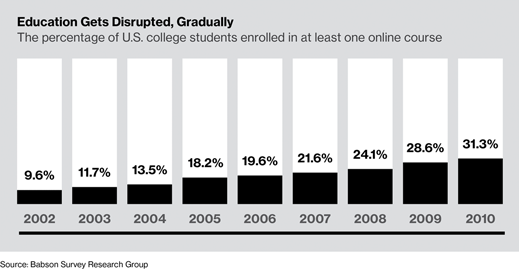
So where are we on the online education curve? According to a study from Babson College, the number of U.S. college students who took at least one online course increased from 1.6 million in 2002 to 6.1 million, or about a third of all college students, in 2010. The researchers, I. Elaine Allen and Jeff Seaman, found signs that the growth rate of online classes might be starting to slow. But their study didn’t anticipate the sudden entry of premier universities into online education this year. Coursera, an alliance between Stanford and two dozen other schools, claims that it had 1.5 million students sign up.
Even though only a small fraction of those will actually complete a class, the rise of the MOOCs means we can begin thinking about how free, top-quality education could change the world. Khan’s videos are popular in India, and the MOOC purveyors have found that 60 percent of their sign-ups are self-starters from knowledge-hungry nations like Brazil and China. Nobody knows what a liberal application of high-octane educational propellant might do. Will it supersize innovation globally by knocking away barriers to good instruction? Will frightened governments censor teachers as they have the Web?
Technology will define where online education goes next. All those millions of students clicking online can have their progress tracked, logged, studied, and probably influenced, too. Talk to Khan or anyone behind the MOOCs (which largely sprang from university departments interested in computer intelligence) and they’ll all say their eventual goal isn’t to stream videos but to perfect education through the scientific use of data. Just imagine, they say, software that maps an individual’s knowledge and offers a lesson plan unique to him or her.
Will they succeed and create something truly different? If they do, we’ll have the answer to our question: online learning will be the most important innovation in education in the last 200 years.

http://www.technologyreview.com/news/506351/the-most-important-education-technology-in-200-years/

MOOC 2012

The year of 2012 seem to be the year of MOOCs
Although MOOCs have been  around for some year it seems that 2012 is the year of MOOCs and stil it looks like it is something in and for the future.Lewin argude teh 13 Novemer 2012 that while massive open online courses, or MOOCs, are still in their early days, the race has begun to integrate them into traditional colleges — by making them eligible for transfer credits, and by putting them to use in introductory and remedial courses.
Ramin Rahimian for The New York Times
Daphne Koller and Andrew Ng, the founders of Coursera, posed in their recording room in Mountain View, Calif., in July.
The American Council on Education, the leading umbrella group for higher education, and Coursera, a Silicon Valley MOOC provider, announced a pilot project to determine whether some free online courses are similar enough to traditional college courses that they should be eligible for credit.
The council’s credit evaluation process will begin early next year, using faculty teams to begin to assess how much students who successfully complete Coursera MOOCs have learned. Students who want to take the free classes for credit would have to pay a fee to take an identity-verified, proctored exam. If the faculty team deems the course worthy of academic credit, students who do well could pay for a transcript to submit to the college of their choice. Colleges are not required to accept those credits, but similar transcripts are already accepted by 2,000 United States colleges and universities for training courses offered by the military or by employers.
Coursera, founded last year by two Stanford computer professors, Daphne Koller and Andrew Ng, has 33 university partners and nearly two million students, who currently can earn certificates of completion, but not academic credit, for their work.
“I feel strongly that degrees are really valuable to people, and having MOOCs allow for credit down the line will increase the number of students with the confidence and wherewithal to complete degrees,” Professor Koller said. “If you’re a random student from another country, what are your chances of being admitted to a university here? But if you can show you’re a motivated student who’s completing five courses and done well on the proctored exam, I think a university would pay attention.”
The project is being watched closely by higher-education experts who expect MOOCs to broaden access to higher education and bring down the costs.
“With the additional benefits of ACE credit recommendation for Coursera courses, students will have an unprecedented opportunity to obtain recognized credentials for their work,” said William G. Bowen, the former president of Princeton University and the Mellon Foundation, and senior adviser to Ithaka, a nonprofit group devoted to digital technologies in higher education.
Also on Tuesday, the Bill and Melinda Gates Foundation announced 13 grants, totaling more than $3 million, for MOOC research. The grants are intended to encourage the development of MOOCs in introductory courses, like developmental math and writing, to see how they might be integrated into community colleges to bolster completion, and to develop a pathway for MOOC transfer credit.
Lewin  argued 13 November  that: While there is some overlap between the Coursera project and the Gates grants, only four of the nine schools that received grants are putting their MOOCs on Coursera, while the others use different platforms.The largest grants go to three groups — the American council, Ithaka and the Association of Public and Land-Grant Universities — that will explore the credit issue, consider a possible consortium for collaborating on digital courseware, and research the University of Maryland’s experience with MOOCs.
“It certainly appears that there is potential here, and we ought to kick all the tires and see what we can learn,” said Molly Corbett Broad, the president of the American council.

Sunday, October 21, 2012

Open Access week 22-28 October 2012

Go open
Sharing is Caring-Caring is sharing

Open Access Week 2012 will be celebrated everywhere from 22 - 28 October 2012, focusing on the theme of "Set the default to Open Access".  The default at the OER Foundation is unquestionably open! 

This year the OER foundation will make a contribution both nationally and internationally joining 2012 celebrations for Open Access Week. This is an opportunity to share and profile the leadership of our OERu anchor partners worldwide. 

In New Zealand, where the OER University has it´s head office is located,they are joining forces with Creative Commons Aotearoa New Zealand and they will contribute a guest blog post. 

On the international front, OERu are joining Athabasca University, one of the founding anchor partners of the OERu for a webinar session with the UNESCO-COL Chair on OER. Rory McGreal will present a session on OER and Mobile learning, followed by a presentation from the OER Foundation entitled:  The OER university: A sustainable model for more affordable education futures

  • Where: Online 
  • When: 22 October 2012, Noon (Canada Mountain Time) -- Check your own time Zone 
Happy Open Access Week! What will you be doing during OA Week 2012?

Tuesday, October 9, 2012

Distanskurser gör högskolan mindre effektiv- men vad är att vara effektiv. Dags att ändra perspektiv för utvärdering

I Sydsvenska Dagbladet (SDS)  kan man idag den 9 oktober 2012 läsa att:

Svenska högskolor måste bli effektivare tycker politikerna. Högskoleverket har fått i uppdrag att föreslå hur. Men tvärtemot politikernas mål, går studenternas prestationsgrad ner. Orsaken: andelen distansstudenter har ökat.

I går gav Expertgruppen för studier i offentlig ekonomi ut en rapport som föreslår en rad åtgärder för är att öka effektiviteten i högskolan. Bakgrunden är att ett sätt att mäta effektivitet i utbildning är att ange studenternas prestationsgrad: man jämför hur många poäng helårsstudenterna har varit inskrivna för att ta ett visst år, med hur många poäng de faktiskt tar. Skillnaden är stor mellan olika slags utbildningar. Och trots att politikerna under många år lagt förslag efter förslag för att prestationsgraden ska gå upp, så har den vikt av neråt under senare år. I snitt tar en heltidsstudent idag ungefär 80 procent av de poäng som studenten var inskriven för. För fem år sedan var det 83 procent. Lena Eriksson, utredare på Högskoleverket (HSV) säger att:
– I stor utsträckning beror det på den ökade andelen distansstudenter.
I början av 2000-talet gick extra pengar till högskolor och universitet som utvecklade erbjudanden om distanskurser. Politikerna ville att personer som inte bodde på universitetsorter också skulle ha möjlighet till utbildning. Det var en väldigt tydlig politisk ambition att öka tillgängligheten för högre utbildning. Sveriges Nätuniversitet inrättas då också med 211 miljoner i budget och lärosätena fick extra tilldelning för nätstudenter och inrättande av nya kurser (Nätuniversitet omorgansierades sedan till NSHU - Myndigheten för nätverk och samarbete inom högre utbildning med ytterligare uppdrag för flexibel utbildning och breddad rekryering. NSHU lades ned vid årsskiftet 2008/2009). Ansvaret decentraliserade och det blev upp till varje lärosäte att driva eller låta bli att driva frågan om distansutbildning.Nu 2012 måste svenska högskolor bli effektivare tycker politikerna. Högskoleverket har fått i uppdrag att föreslå hur. Men det är lättare sagt än gjort säger Anders Viberg, projektledare för effektivitetsuppdraget på HSV och suckar lätt vid frågan om de utvecklat några bra metoder. Han kontrar med bra motfrågor. – Effektivitet för vem? För studenten, för lärosätet, för regeringen eller för samhället?

 
När politiker pratar effektivitet i högre utbildning menar de att studenterna ska börja högskolan snarast möjligt efter gymnasiet, samt bli fort klara med utbildningen. Men det kanske inte alls är det effektivaste för exempelvis distansstudenter som läser enstaka kurser på deltid. I den studie som SCB just publicerat under 2012, Distansutbildning på högskolan som rör uppföljning av distansutbildning 2010 framkommer tydligt att för distansutbildning har vi oftast en helt annat studiekategori. Den uppföljning som Lunds universitet just genom för från SCBs undersökning pekar mot exakt samma sak, nämligen (Ossiannilsson i manus)
– Vissa läser kanske inte för poängen utan av rent intresse, för att bilda sig.Många hade aldrig läst på högskolan om de inte kunde läsa på distans, dvs att flytta till en stad och läsa på Campus ahde varit omöjligt för många

Att kräva många poäng kan vara effektivt för lärosätena men inte för studenten, säger Anders Viberg
HSV funderar på att presentera några olika modeller för att mäta effektivitet, beroende på perspektiv. Men oavsett perspektiv så är det svårt att mäta effektivitet på utbildning, jämfört med exempelvis varuproduktion. Ett enkelt sätt för det enskilda lärosätet att uppfylla politikernas krav skulle vara att strypa distansstudierna. – Men om alla lärosäten skulle göra det kan man undra vad det betyder för den samhälleliga effektiviteten.

Så effektiv och lönsam för vem?
Troligen är det hög tid att ompröva utvärderings metoderan och frågeområdena och framför allt att distans utbildning och Campus utbildning inte kan jämföras rakt över.

Förslag för ökad effektivitet som föreslås är
  • mer samarbete högskola/gymnasieskola
  • ingen antagning enbart via högskoleprov
  • betyg i vissa ämnen viktas tyngre
  • mer undervisning och fler tentor på utbildningar med låg genomströmning
  •  fler studieplatser på populära utbildningar
  • gör om fristående kurser till programutbildningar (vilka ofta har högre genomströmning)
  • studeilån villkoras
  • högskolan får utfärda examen utan att studenten bett om det
  • ..... eller ändra på hela utvärderingssystemet, min kommentar, efter ca 10 års erfarenhet av distansutbildning och efter att ha djupdykt i SCB material för Lunds universitet!


Thursday, October 4, 2012

Öppet lärande - utmaningar och möjligheter


Webbseminarium om OER 11/10 - Öppet lärande - utmaningar och möjligheter

Det har talats om en "tsunami" inom högre utbildning och flera högt rankade amerikanska universitet bedriver gratis utbildning online på bred front. När de bästa föreläsarna finns tillgängliga för alla helt gratis på internet och när universitets- och högskolekurser finns fritt tillgängliga ett musklick bort – vad gör då studenten, läraren och universitetsledningen? Och vad säger forskaren?

Det är temat för ett nytt webbseminarium, Öppet lärande - utmaningar och möjligheter, som ingår i projektet OER - Öppna möjligheter för lärande som stöds av Internetfonden.
Vi kommer att höra:
  • Max Patzauer, studerande, teknisk fysik, KTH
  • Ambjörn Naeve, forskare, medieteknik och interaktionsdesign, KTH
  • Åsa Bergenheim, rektor vid Karlstads universitet
  • Satish Patel, språklärare vid Linnéuniversitetet samt IKT-pedagog vid HumLab, Umeå universitet
De framför sina tankar och idéer kring ämnet. Vi bjuder in alla intresserade att vara med att lyssna, kommentera och ställa frågor via chatten och upptäcka webbinariets möjligheter till öppet kunskapsutbyte.

Tid: 11 oktober 2012, 14.00-15.00
Plats: Virtuellt mötesrum i Adobe Connect.
Observera! Adressen till mötesrummet kommer att mejlas till alla anmälda 1-2 dagar innan webbinariet.

Mer om seminariet samt anmälan

Webbinariet arrangeras av ITHU, .SE, SUNET och nätverket Dela! Det är kostnadsfritt och öppet för alla intresserade. KTH Learning Lab är en av initiativtagarna och arrangörerna bakom serien. Varje månad fram till sommaren arrangerar vi nya spännande och aktuella webbseminarium. Missa inte detta tillfälle att fördjupa dig i några av kursens teman och dela erfarenheter med kollegor runt om i Sverige.