Welcome to my blog on Quality, elearning, OER, OEP, OEC, and user generated content (UGC)


The posts in my blog will be both in English and Swedish.
Blogposterna kommer att vara både på svenska och engelska.
Showing posts with label Ossiannilsson. Show all posts

Friday, November 3, 2017

ICDE OER Advocacy Committee

ICDE OER Advocacy Committee


At the 27th ICDE World Conference in Toronto, October 2017, ICDE launched a committee
for the global advocacy of OER as a reinforcement and support to the ICDE Chairs in OER.
Paul Bardack, the Chair Emeritus of the United States Distance Learning Association, serves
as the first Chairperson of the Committee, that works to increase global recognition of OER;
and to provide policy support for the uptake, use and reuse of OER.
First I am really honored and pleased to have been appointed Ambassadors for the global
advocacy of OER, but also to be in the core group. Looking forward to the work ahead.
All members of the ICDE Advocacy Committee are appointed Ambassadors for the global 
advocacy of OER for a limited term until end 2019. A smaller group of the members form a
core group that works more closely with the chair to facilitate the activities of the Committee
and its members:
Core group members:
  • Mark Brown, Office of the Vice President, Dublin City University, Ireland
  • Ebba Ossiannilsson, Consultant and VP, Swedish Assocation of Distance Education (SADE), Sweden
Other Advocacy Committee members:
  • Cengiz Hakan Aydin, Professor, Anadolu University, Turkey
  • Paul Bacsich, Director and Senior Consultant, Matic Media and Sero Consulting, United Kingdom
  • Chandra Shekhar Dubey, Director, Campus of Open Learning, Dehli University, India
  • James Glapa-Glossklag, Dean and Treasurer of the Board, College of the Canyons and Open Education Consortium, USA
  • Dhaneswar Harichandan, Director, Institute of Distance and Open Learning, University of Mumbai, India
  • Gary Matkin, Dean of Continuing Education, UC-Irvine California, USA
  • Jean-Marc Meunier, President and VP, FIED and University of Paris VIII Vincennes – St-Denis, France
  • Valerie Peachey, Professor in Open Education, Charles Sturt University, Australia
  • Xiangyang Zhang, Open University of Jiangsu, China
  • Cable Green, Lead OER, Creative Commons, US
Read the full Blog post by  for ICDE here
Paul Bardack, the Chair point to nine advocacy actions
  1. Advocate for national and sub-national governments to require all research funded publicly to be openly accessible to all.
  2. Advocate for expanded government funding of peer reviewed online content that is to be open and accessible to all.
  3. Advocate for expanded recognition of prior learning experiences and other alternative paths for receiving course credit, including open content and open access.
  4. Advocate for expanded government funding of personally owned laptops and smart phones, to allow the benefits of open access to be available to all.
  5. Advocate for more government funding of wired and wireless networks, so that those in poorer communities are not left behind.
  6. Advocate for changes to national intellectual property laws, to allow more content to be freely accessible by potential users of that content.
  7. Advocate with the nonprofit and private sectors to encourage more government and nongovernment money to go towards funding of openly accessible online content and courses.
  8. Advocate the end of censorship of educational content.
  9. Make it physically safe for those who must leave their homes to get an education to get the education they seek without fear of physical harm.

Relevance to ICDE

Upon further reflection, those actions will require at least some, and perhaps many, changes to government policy, in my country and in countries around the world.
And that is precisely why ICDE just launched, at the World Conference on Online Learning in Toronto, a new OER advocacy committee … to help empower those of us around the world who believe in the power and promise of open and distance education; and to help reshape our national and subnational laws and policies to help the people of the world to make that dream a reality.
Read the full Blog post by  Paul Bardack for ICDE here

Tuesday, October 3, 2017

The Blended Learning Ecosystem: Taking Control And Orchestrating Learning Pathways

Ebba picContributed by: Ebba Ossiannilsson, Vice President of the Swedish Association for Distance Education, Vice President of the Swedish Association for e-competence, ICDE OER Advocacy Committee, ICDE Focal Points of Quality, ICDE_ON_BOLDIC, EDEN EC, EDEN Fellow, EDEN SIG on TEL Quality Enhancement, Open Education Europa Fellow and Ambassador.
During the 27TH ICDE World Conference, 16-19 October 2017, Toronto, Canada, ICDE will be releasing the third installment of its ICDE Insight Papers Series. 
Ebba Ossiannilsson, author of the ICDE Insight Paper provides an overview of what readers can expect from this publication. 
This blogpost on blended learning can be followed my the ICDE Blog as well
This ICDE Insight Paper on blended learning, state of the nation, targets a broad audience, especially practitioners, policy makers and leaders. It provides awareness, inspiration, insights, and dialogues into blended learning and the current debates. The report explains that blended learning is based on a pedagogical approach rather than on technology.
Blended learning involves people as learners, teachers, administrators, technicians, leaders, and managers with a variety of aspirations and ambitions. Clearly, there is a renewed focus on quality, and the blended learning approach is worthy of consideration.

What is Blended Learning?

Numerous definitions have emerged during the last 20 years, demonstrating the wide-ranging nature of the concept, its socio-cultural influences, and its flexible interpretations. Blended learning is part of the innovative transformation of education in the 21st century.
Blended learning embraces personal quality learning. This widely recognized and personalizable method engages, facilitates, and supports learning. UNESCO and the Commonwealth of Learning emphasize this approach, as it makes learning more flexible and convenient. This will help students be part of a global digital society.
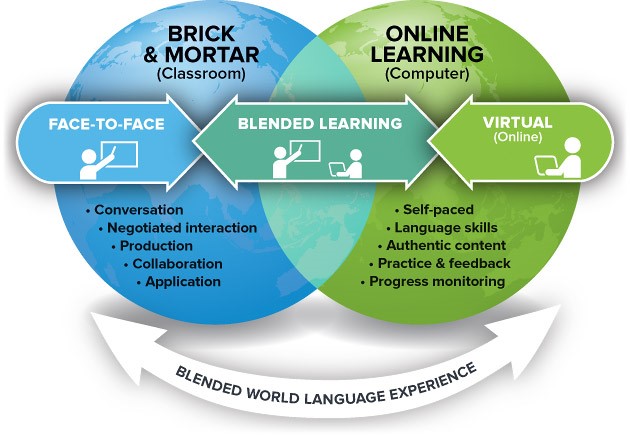
The blended learning model requires changes in the roles of both teachers and learners. These changes are accompanied by shifts in ownership and empowerment, where learners become prosumers and orchestrate their own learning regarding time, place, setting, path, and pace. A common model is pictured below.
ebba 2
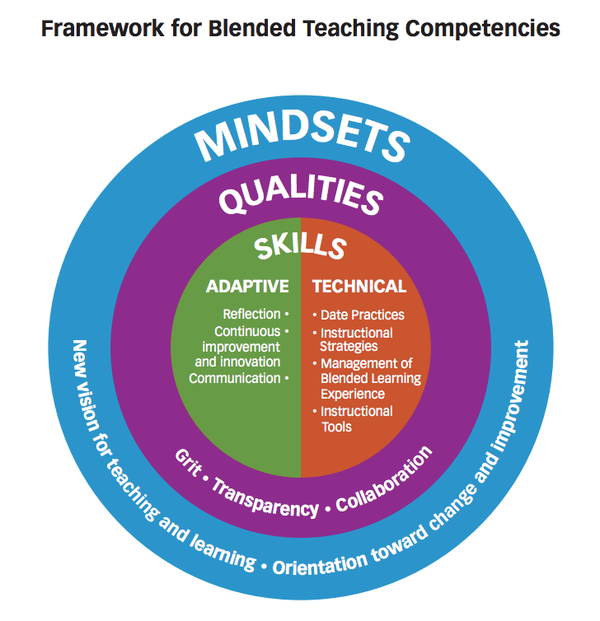
To adapt to current trends and contexts, blended learning models must be flexible, and agile. One framework is by the International Association for K-12 Online Learning (iNOCAL).The below graphic describes how engaging, efficient, and effective learning starts with specific mindsets.
Ebba 1
A set of recommendations for blended learning are given in this ICDE Insight paper:
  1. Success is based on people.
  2. Promote the ownership of learning.
  3. Ensure that strategies, funding, and visions are understandable to all.
  4. Implement a culture of smart learning, open pedagogy, and mobile learning.
  5. Enable ubiquitous learning, time (anytime), space (anywhere), path, mode, and access.
  6. Apply the UNESCO Bangkok and the Education University of Hong Kong recommendations.
  7. Apply the INOCOL framework of blended learning.8. Support and facilitate capacity building, incentives, and recognition in all staff.
  8. Cultivate a culture of quality and an ecology of blended learning.
  9. Encompass digitization throughout the curricula and assessments, including finding, evaluating, creating, disseminating, and communicating.
  10. Ensure that blended learning concerns all stakeholders at micro, meso, and macro levels.
  11. Ensure that leadership and management at all levels support and facilitate the culture and quality of blended learning.
  12. Conduct research that focuses on blended learning per se not only in comparison with other teaching and learning models.

Where you come in?

Please discuss the possibilities and ask any questions necessary to improve your understanding. I look forward to your comments and involvement in this movement.
Ebba Ossiannilsson

Saturday, October 3, 2015

Open Education Europa Portal Anniversary October 2015


Bildresultat för open education europa

The 1st of October 2015 Open Education Europa celebrated its 2 years anniversary. 

A lot of activities were taken placeduring the anniversary.The day before a TweetChat was held and moderated by Ass Professor Steve Wheeler, Plymouth University, UK. The Tweetchat can be followed in Storyfy on the link as below.


Open Education Europa Fellows 2015, like myself, had been asked to send greetings to Open Education Europa Portal, so here is my introduction and my greetings at YouTube.


Dr. Ossiannilsson works in national and international associations in the area of open online learning and education and serves as board member or on consultancy. Just to mention some: EADTU (European Association of Distance Teaching Universities),ExcellenceOpenupEd (MOOCs), EPPROBATE,  EDEN (European Distance and e-Learning Network), EFQUEL (European Foundation for Quality in e-Learning), EUCEN(European Universities Continuing Education Network), SADE/SVERD (Swedish Association of Distance Education) and Campus NOOA (Norway)

I have a passion about developing and contributing to open education for a Future We Want for All, like UNESCO stated at their Policy Forum in Paris 2015.


See also my profile at Open Education Europa


 Open Education Europa Teachers Contest was launched during the anniversary aiming at collecting and sharing innovative teaching practices taken place in Europe.


The contest aims at European teachers and educators in primary, secondary and higher education, vocational training and adult learning who teach in an innovative way or aim to achieve greater openness or inclusion in the classroom.

To participate in the contest, please submit electronically a Good Practice you were personally involved in. We define “Good Practice” in education as an action, initiative or experience that enhances learning and combines one or more of the following principles:
  • Innovation; the application of a novel approach, method or resource to improve teaching or learning.
  • Openness; the use or production of resources that are shared freely; the opening up of the classroom with open educational practices.
  • Inclusion; providing access to education or training to a previously excluded group or audience.
For the contest we will also consider the Replicability of the practice; whether it is easy for colleagues in other countries to apply and adapt the practice.

Everyone taking part in the OEE Teachers Contest will receive the “Open Education Europa Pioneer” badge and have a chance to win a trip to an innovative school in Europe.

We invite innovators from all all disciplines, fields and levels of education who use successfully various approaches and resources to share their good teaching practices until October 31th, 2015!

We are looking forward to meeting you online and learning about your successful practices!

Start here and good luck!


Wednesday, February 5, 2014

Rhizomatic Learning - The community is the curriculum, week 4

Weeke 4 Are books making us stupied

The challenges for this week in the very interesting course on rhizome learning, the community is the curricula:

  • Are books making us stupid? 
  • Have they always? 
  • What has the medium of print done to learning? 
  • What are the implications of this objective distance? 
  • How does it impact what we believe is valid in our society both inside learning and outside of it? 
I will argue that any kind of media has its benefits and limitations
The nice thing with social media is that it easy to be connected, it is easy to be on track, it is easy to be in a community, it is an often gente and generous athmosphere, everyone is willing to share and to be part.

Of course some limitations are that it can be barriers for those who are not digital skilled or not very socia. Being not very social is not just due for socail media, and on Internet of course
There can be limitations that everything is so fast with social media, you los sometimes time for reflections, further consideration, and second thoughts

With books and printed material there are benefits in some ways, it is solid in one way, but on the other had as soon as a book is printed, it is old, and imagine it takes appro 1 year or even more to publish, print etc. This is teh same with Journal articles, with the review system etc. On the other hand they are more sustainable

The printed word is solid, it cant easy be changes, the oral word can be changes in teh same time it is said

As the saying is

Carve praise in stone, write criticism in sand

Rhizomatic Learning - The community is the curriculum- Week 3

This week is about how to embrace uncertainty in learning


I  will argue that the more you are wondering about, and the more  curious you are and try to discover, the more you learn. Learning is not about questions and answers, nor about right and wrong. Learning is rhizomatic, serendepedy and uncertain. You don´t really know where you end up, but you need to know your goals and your own directions, The way forward is however not just straight on...

As Cormier is emphasizing in this videoclip it is very much about
  • Orient
  • Declare
  • Network
  • Cluster
  • Focus
If you learn those five steps you might learn most everything, and I agree that those five steps facilitate uncertain learning. You have to embrace uncertainity, and find ways which are reachable. It i also important to give up power approaches, you have different approaches and can share,

Tuesday, February 4, 2014

Rhizomatic Learning - The community is the curriculum


One of the two MOOCs I have reg for and started now in the beginning of 2014 is

I realy love this course and its title. Rhizomatic Learning- the  community is teh curriculum
and as  Dave says: "Doing this course I've put together a blog post to give you a sense of 'where' the course is happening and what you might like to do as part of it."  In the info about the course it starts with "Your unguided tour of Rhizo14". I really just live the approach.

course image

Rhizomatic learning is a story of how we can learn in a world of abundance – abundance of perspective, of information and of connection. A paper/location based learning model forces us to make decisions, in advance, about what it is important for students to learn. This was a practical reality – if we were going to have content available for a course, it needed to be prepared in advance. In order to prepare the content in advance, we needed to prepare the objectives in advance. And, given that we know what everyone is supposed to learn, we might as well check and see if they all did and compare them against each other.
What happens if we let that go? What happens when we approach a learning experience and we don’t know what we are going to learn? Where each student can learn something a little bit different – together? If we decide that important learning is more like being a parent, or being a cook, and less like knowing all the counties in England in 1450? What if we decided to trust the idea that people can come together to learn given the availability of an abundance of perspective, of information and of connection?


I  really love and I am really dedicated to the rhizome way of thinking and learníng, In my dissertation on Benchmarking in higher edcuation- lessons learned from interantional projects, I argued for a rhizome model of quality enhancement, actually I have the rhizome theory as a frame of reference in my research.

 the work by Gilles Deleuze and Félix Guattari

Gilles Deleuze and Félix Guattari use the term "rhizome" and "rhizomatic" to describe theory and research that allows for multiple, non-hierarchical entry and exit points in data representation and interpretation. In A Thousand Plateaus, they oppose it to an arborescent conception of knowledge, which works with dualist categories and binary choices. A rhizome works with planar and trans-species connections, while an arborescent model works with vertical and linear connections.

As a model for culture, the rhizome resists the organizational structure of the root-tree system which charts causality along chronological lines and looks for the original source of 'things' and looks towards the pinnacle or conclusion of those 'things.' A rhizome, on the other hand, is characterized by 'ceaselessly established connections between semiotic chains, organizations of power, and circumstances relative to the arts, sciences, and social struggles.' Rather than narrativize history and culture, the rhizome presents history and culture as a map or wide array of attractions and influences with no specific origin or genesis, for a 'rhizome has no beginning or end; it is always in the middle, between things, interbeing, intermezzo.' The planar movement of the rhizome resists chronology and organization, instead favoring a nomadic system of growth and propagation.
"In this model, culture spreads like the surface of a body of water, spreading towards available spaces or trickling downwards towards new spaces through fissures and gaps, eroding what is in its way. The surface can be interrupted and moved, but these disturbances leave no trace, as the water is charged with pressure and potential to always seek its equilibrium, and thereby establish smooth space.


Deleuze and Guattari introduce six principles:
  • 1 and 2: Principles of connection and heterogeneity: any point of a rhizome can be connected to any other, and must be
  • 3. Principle of multiplicity: only when the multiple is effectively treated as a substantive, "multiplicity" that it ceases to have any relation to the One
  • 4. Principle of asignifying rupture: a rhizome may be broken, but it will start up again on one of its old lines, or on new lines
  • 5 and 6: Principle of cartography and decalcomania: a rhizome is not amenable to any structural or generative model; it is a "map and not a tracing"


The very first task in this course is to reflect on
Use cheating as a weapon. How can you use the idea of cheating as a tool to take apart the structures that you work in? What does it say about learning? About power? About how you see teaching?

This is  really a challenge as such. Knowledge has always build on what others are doing of course one has  to give recognition to teh one/s who create thíng, but is it always easy to know who was teh firsst one, A lot of knowledge is so called common knowledge, and as such always has benn known.  By cheating you can learn a lot as well, you just have to know how  you can use it and what it means.  It is strange there as alway been some strange opinion that knowledge ahs to do with power. Some know more than others, and as such have "higher" status.
It would be nice, if an assignment in HE should say to students , cheat as much as you can, and tehn discuss waht we can learn about it. ONe thing for sure, is how to deal with Creative Commons, Copyright,  referrie rules, acknoledgement etc . Could be a nice starting point

I think with a rhizome mindset, sharing is caring, and caring is sharing. Together we gain knowledge and experiences and learn to network

 #rhizo14

@EbbaOssian


Sunday, September 8, 2013

OCL4Ed2013

I am one of the facilitators of the course OCL4Ed2013 together with Wayne Mackintosh,  Tel Amiel and Rory Mc Greal.
This blog e4qualityinnovationand learning is my  regular blog, and i will share my rflections on the course OCL4ED2013 here as well. The course started the 4th Of September and will last to the 18th of September 2013.

I am a PhD and a Project Manager at the Centre for Educational Development (CED), and at the Evaluation Office at Lund University, SE. In Dec 2012 I was appointed to take the lead for Lund University to go towards open education, MOOC, OER etc. and to investigate strategic missions on e-learning for Lund University. I earned my PhD from Oulu University, FI (14/12/2012). Myr research is on international benchmarking, quality and quality enhancement on e-learning in Higher Educational Institutions.

I strongly believe and share the open education movements ideas that access to education is a fundamental human right. This course, the OCL4Ed2013 is contributing to the inevitable outcome in the future where open education will be taken for granted by all education institutions.

Unfortunatly, today many education institutions restrict access to learning by locking content behind all rights reserved copyright. In today's world where the cost of replicating digital information is near zero combined with the affordance that the cost of developing high quality courses collaboratively using open educational resources is far cheaper than doing this alone, we have unprecedented opportunities to promote the sustainability of education futures for all.

This micro Open Online Course (mOOC) on open content licensing OCL4Ed 2013 introduces the concepts of open education, copyright and Creative Commons as a contribution from the OER university collaboration and the UNESCO-COL OER Chair network in widening knowledge and capacity development in support of the global open education movement.

The course is freely available for anyone with an interest in open education with options to earn certificates of participation or formal assessment for tertiary academic credit. This course guide provides and overview of the course and assessment options available for participants.

Sunday, December 30, 2012

Benchmarking e-learning in higher education : Lessons learned from international projects

Benchmarking e-learning in higher education: Lessons learned from international projects was the title of my dissertation which I public defended the 14th December 2012, at University of Oulu Graduate School, University of Oulu, Faculty of Technology, Department of Industrial Engineering and Management, Finland.

The academic dissertation was presented with the assent of the Doctoral Training Committee of Technology and Natural Sciences of the University of Oulu for public defence in Auditorium IT116, Linnanmaa, on 14 December 2012, at 12 noon.
For further information and download pdf and ebook, click here 

Tutors were:
Professor Pekka Kess
Doctor Pekka Belt

Reviewers were:
Professor Janerik Lundquist, Linköping University, SE
Doctor Keith Williams; Open University, UK

 Me and my Opponent Dr Terence Karran, Lincoln University, UK
Me and my Supervisor, Professor Pekka Kess, Oulu University, FI
Me and my second Supervisor, Dr Pekka Belt,Oulu University, FI

Abstract is also available in Finish and Swedish
Higher education is facing a range of major challenges during the twenty-first century. Personalised, flexible and open learning are considered among the driving forces, thus, issues of quality must be urgently addressed.
    This qualitative, multiple-case-study research with single and cross-case analysis focuses on benchmarking e-learning in higher education. The results of this study include providing conceptual lenses with which to see, discuss and perceive the complexity of benchmarking e-learning in higher education in extended, stretched and boundless learning environments. It has become obvious through the research that there is a need for new frames of reference for quality in e-learning. The choice of theoretical foundations for benchmarking e-learning will impact the consequences of accomplishing and selecting benchmarks.
     This research provides directions and recommendations for the future regarding how to accomplish benchmarking e-learning in extended learning environments in which students can study, work and live independently of time and space with global resources at their disposal in lifelong learning environments. The greatest challenge identified in this study for integrating benchmarking e-learning into general quality assurance is the fact that the required changes related to and demanded for e-learning are not fully understood. The research shows that benchmarking as a method will have a significant impact on ordinary quality assurance in higher education.
        This doctoral dissertation revealed challenges to integrate external quality audits and internally driven benchmarking. The studies have likewise revealed the need for methodological changes by quality assurance bodies and authorities carrying out audit and accreditation for integrating e-learning into quality assurance, as well as the need to fully understand the complexity and the special characteristics of e-learning. Probably, the challenge lies not with the system, success factors or benchmarks but in the lack of knowledge and experience of e-learning systems amongst those charged with implementation. The concept benchlearning was introduced as part of benchmarking exercises.